People ask me all the time: if I only have one day, one cenote, which one do I choose?
My answer depends on who's asking. For cave-certified divers chasing darkness and depth, I point them toward Angelita or Dos Ojos. But for the diver who has one day, some experience with overhead environments, and wants to walk away having seen everything the cenote world has to offer — light beams, a halocline, ancient fossils, a jungle-green cavern entrance — I tell them Chac Mool. Every time.
Chac Mool is the cenote I describe as the best-of. Not because it's the deepest or the most dramatic, but because it packs more distinct features into a single dive day than almost any other site in the region. If you've already logged dives in a few of the more crowded cenotes and you're wondering which site actually rewards a certified diver who knows what to look for, this is the one.
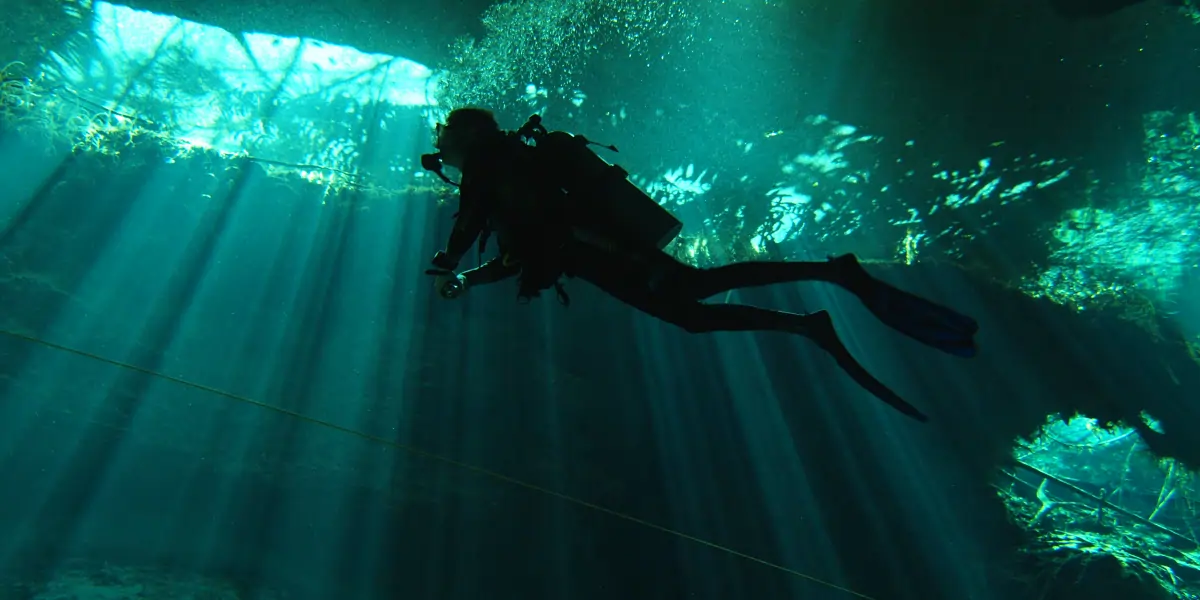
Two Cenotes, One Dive Day: Chac Mool and Kukulkan
The first thing to understand about Chac Mool is that you're really diving two connected cenotes in a single outing. You enter through a passage nicknamed “Little Brother,” and from there the route takes you between Cenote Chac Mool and Cenote Kukulkan, with the option to complete one dive in each during the same day.
Unlike some of the narrower cave systems in the area, Chac Mool is a wide, open cenote. That doesn't make it any less interesting — if anything, it gives you more room to move, better sightlines on the formations, and none of the tight, pressed-in feeling some cavern routes have. I've been guiding groups through the Riviera Maya for more than 30 years, and Chac Mool is still one of the first sites I recommend to divers who are just getting comfortable in an overhead environment — and one of the sites experienced divers enjoy just as much, simply for the ease and generosity of the route.
The Chac Mool Halocline: Less Talked About, Just as Impressive
When people talk about haloclines in the Riviera Maya, most divers think of Angelita first, or one of the deeper technical sites. But Chac Mool has its own, and at a maximum depth of just 12.5 meters, it's far more accessible than those alternatives.
Here's what's happening: the Yucatán cenote system holds fresh water near the surface, fed by underground rivers. Deeper down, salt water from the Caribbean has seeped in through the limestone. Where the two meet, you get a halocline — a visible boundary layer where the difference in density creates a blurry, shimmering effect that genuinely distorts whatever you're looking at through it.
In Chac Mool, when you drop down into the saltwater layer and look up through the halocline, it looks like a slow river flowing over your head, inside the water. It's disorienting and beautiful at the same time. There's a temperature shift at the boundary too — the salt water runs slightly warmer — so your body registers the crossing before your eyes finish processing it. I've taken hundreds of dives through this halocline over the years, and it still gets me to stop and look up for a second. It doesn't wear off.
Ready to see the Chac Mool halocline for yourself?
Book your Chac Mool cenote dive with Us and let 30 years of cenote-guiding experience in Playa del Carmen take care of the rest.
Kukulkan: Light Beams and Ancient Coral Fossils
The Kukulkan section has a side opening that lets sunlight enter the cenote at an angle most underwater photographers spend years chasing. On a clear morning the beams cut straight through the water and scatter across the rock formations — rainbows on the walls, rippling columns of light shifting as the surface moves above. I've seen divers with hundreds of dives logged just stop mid-route, hover, and watch it. I don't rush them. Honestly, neither do I.
But Kukulkan isn't just about light. Millions of years ago, the Yucatán Peninsula sat at the bottom of a tropical sea, and the limestone that now forms the jungle floor — and the caves beneath it — was once a coral reef. In the walls of Kukulkan you can still see shells, coral fossils, and imprints of ancient marine life. I ask my guides to point them out to every group: they're easy to miss the first time, but once you spot your first one, you start noticing them everywhere.
The Little Brother Entrance: The Green Wall
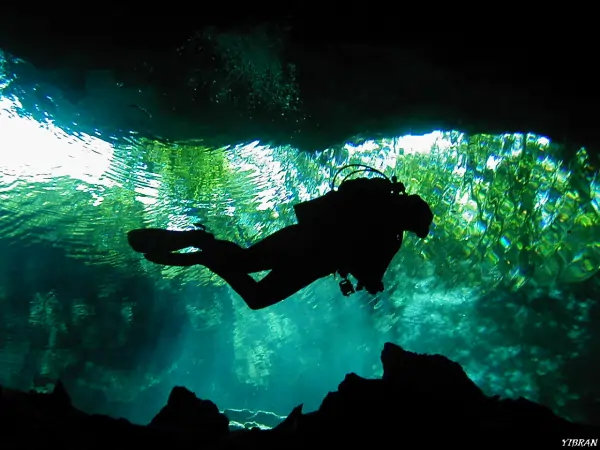
The entrance to Cenote Chac Mool through “Little Brother” is one of the more quietly spectacular — and less talked-about — moments in cenote diving. You drop through a narrow passage and, suddenly, the cavern opens into a vast, glowing green arch: jungle trees, roots, and boulders pressing in from above, with light filtering down in thick green sheets.
The first time I took a group through it, one of my divers surfaced and said it looked like something out of a sci-fi movie — the color looks almost too vivid, like someone turned the saturation up on the world. Years have passed since then and I still hear the same comment, season after season. It's the kind of moment that never quite makes it into the typical cenote marketing photo, but it's the one divers remember.
Chac Mool vs. Dos Ojos: Which Should You Choose?
It's the question I get most from divers who've already done Dos Ojos and are planning their next cenote day. Here's the quick comparison:
| Cenote Chac Mool | Cenote Dos Ojos | |
| Maximum depth | 12.5 meters | 10 meters |
| Halocline | Yes, pronounced and accessible | Not its main draw |
| Certification required | Open Water | Open Water |
| Crowd level | Less crowded | More popular and heavily trafficked |
| Signature advantage | Two connected cenotes (Chac Mool + Kukulkan) in one dive day | Barbie Line and Batcave routes, Sac Actún cave system |
Who Is Chac Mool Cenote Diving Right For?
Chac Mool is built for certified divers, Open Water and up; no cave certification is required for the main route, since it's a wide, well-lit cavern environment. That said, it's still an overhead dive, so supervision from a cavern-certified guide is required at all times.
If you've already dived Dos Ojos and Cenote Jardín del Edén, Chac Mool is the logical next stop on your list — less crowded than Dos Ojos, with a more accessible halocline than the deeper technical sites, and the added benefit of combining two cenotes, Chac Mool and Kukulkan, in a single dive day.
Frequently Asked Questions About Chac Mool Cenote Diving
What certification do I need to dive Cenote Chac Mool?
An Open Water certification is enough. No cave course is required for the main route, though the dive is always led by a cavern-certified guide.
How deep is Cenote Chac Mool?
It reaches a maximum depth of 12.5 meters, which makes it far more accessible than other halocline sites in the region without losing any of the effect's impact.
Can I dive two cenotes in one day?
Yes. Chac Mool connects to Cenote Kukulkan, and a typical day includes one dive in each, entering through the passage known as Little Brother.
Is Chac Mool better than Dos Ojos for a certified diver?
Neither is better — they're different. Dos Ojos is better known and more heavily trafficked; Chac Mool offers a less crowded experience, its own halocline, and the option to combine two cenotes in one outing.
Can I take photos or video inside Chac Mool?
Yes, always following your guide's instructions on lights or flash, especially near the halocline or delicate formation areas. Keep in mind that camera use may carry an extra cost depending on the cenote, since it isn't included in the base tour price — ask about the details when you book.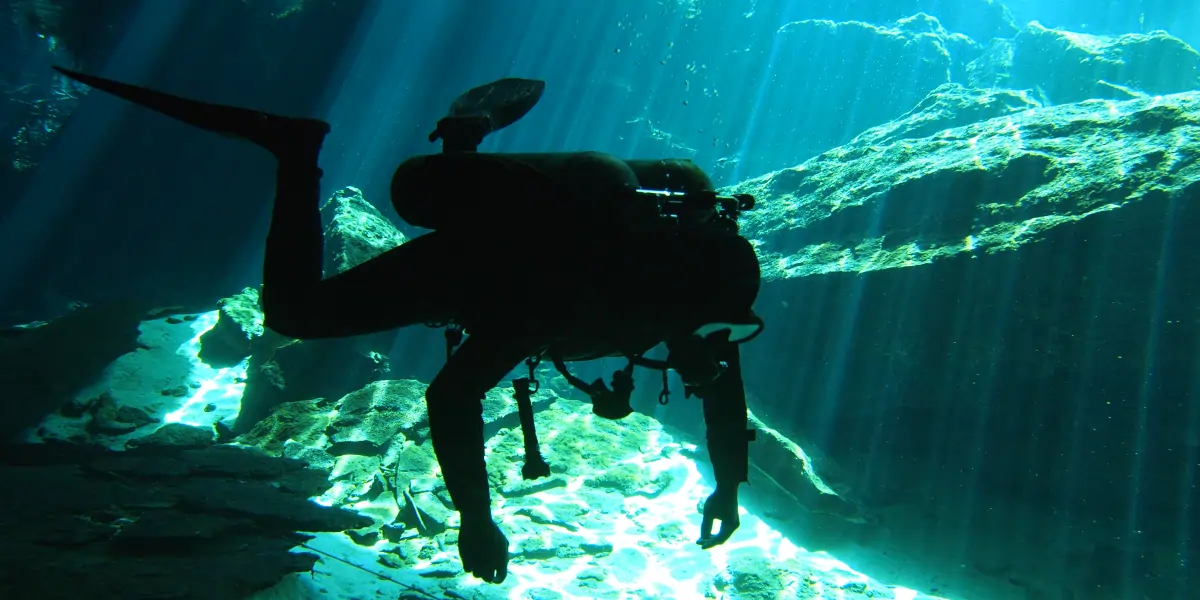
Dive Cenote Chac Mool with Deep México
Chac Mool doesn't need overblown adjectives to sell itself: an accessible halocline, natural light beams, ancient coral fossils, and an entrance as photogenic as Little Brother speak for themselves. What does make the difference is who you dive it with — we've been guiding cenotes in Playa del Carmen for over 30 years, and we know exactly where along each route it's worth stopping to look.
If you're already certified and want to make the most of your one cenote day in the Riviera Maya, this is the site that gives you the complete experience in a single outing.
Book your Chac Mool cenote dive with Deep México today.
Tell us your certification level and travel dates — we'll take care of the rest.
Phone: +52 984 157 5464
Email: booking@deepmexico.com
Deep México · Playa del Carmen, Riviera Maya · PADI Store PIN: 5982 · +30 years of experience · Guides in English, Spanish, German, Italian and French